By the accounts of Herodotus, Homer, Hierocles and their literary peers, the ancient Greeks believed in a race of blond giants, living in complete happiness to the age of a thousand years, inhabiting a land far to the north where the sun shines day and night. They were the Hyperboreans, and their homeland was variably believed to be located in places such as the Balkans, Britain or beyond the Urals.
Genetic research has showed that hunter-gatherers of the Siberian mammoth steppe carried the allele associated with blond hair in Europeans, and that both Europeans and Native Americans are partly descended from this people - referred to in genetic literature as the Ancient North Eurasians (ANE).
The 2012 paper "Ancient Admixture in Human History" by Nick Patterson et al. was the first to suggest an Ancient North Eurasian ghost population contributing genetic material to several modern populations, attempting to explain the mysterious signal of affinity between Europeans and Native Americans.
http://www.genetics.org/content/early/2012/09/06/genetics.112.145037
In 2014, Raghavan et al. published the genomes of Upper Paleolithic hunter-gatherers from Siberia, proving not only the existence of the Ancient North Eurasians, but also that they carried the male haplogroup R*, the ancestral clade of European haplogroups R1a and R1b. Mitochondrial haplogroup U was also found, the ubiquitous maternal lineage of Mesolithic Europe, also very common among contemporary Europeans.
[W]e sequence the draft genome of an approximately 24,000-year-old individual (MA-1), from Mal’ta in south-central Siberia, [...] To our knowledge this is the oldest anatomically modern human genome reported to date. [...] We find autosomal evidence that MA-1 is basal to modern-day western Eurasians and genetically closely related to modern-day Native Americans, with no close affinity to east Asians. This suggests that populations related to contemporary western Eurasians had a more north-easterly distribution 24,000 years ago than commonly thought. [...] Sequencing of another south-central Siberian, Afontova Gora-2 dating to approximately 17,000 years ago, revealed similar autosomal genetic signatures as MA-1, suggesting that the region was continuously occupied by humans throughout the Last Glacial Maximum.
https://www.nature.com/nature/journal/v505/n7481/full/nature12736.html
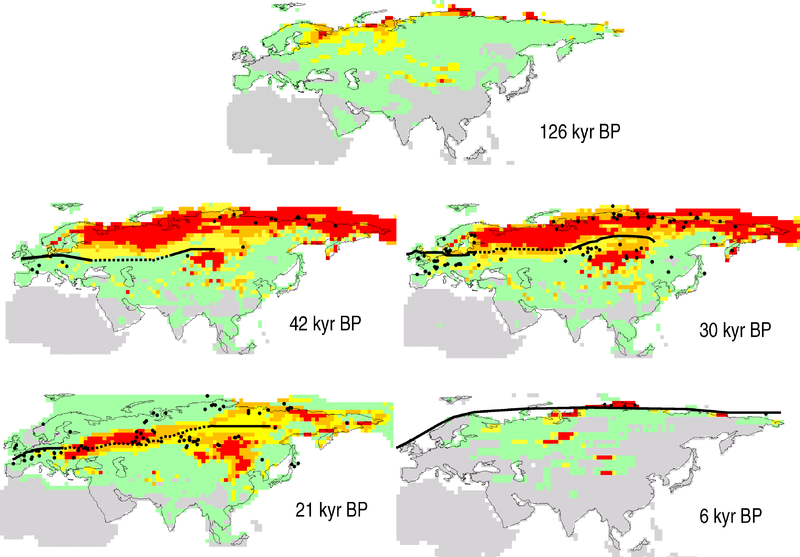
The classic Haak et al. paper showed that significant ANE-related admixture entered parts of Europe in the early Holocene as the glaciers of the last Ice Age waned. Considering that the Ancient North Eurasians of the Afontova Gora and Mal'ta Buret cultures were relying on hunting mammoths for food, clothing, building materials as well as ivory tools and weapons, it is possible that the reduced habitat and eventual extinction of the woolly mammoth around 12,000 years ago was a contributing cause of the ANE introgression into Europe, mixing with the indigenous Western Hunter-Gatherers to form the Eastern Hunter-Gatherers. The Eastern Hunter-Gatherers likely spoke a very archaic form of Proto-Indo-European, and contributed significantly to the formation of the Steppe genotype, characteristic of Yamnaya and related cultures speaking dialects of early Proto-Indo-European during the Copper Age in Eastern Europe.
[T]wo hunter-gatherers from Russia included in our study belonged to R1a (Karelia) and R1b (Samara), the earliest documented ancient samples of either haplogroup discovered to date. [...] They have affinity to the 24,000-year-old MA1, the type specimen for the Ancient North Eurasians (ANE) who contributed to both Europeans and Native Americans. The two hunter-gatherers from Russia (Karelia in the northwest of the country and Samara on the steppe near the Urals) form an ‘eastern European hunter-gatherer’ (EHG) cluster at one end of a hunter-gatherer cline across Europe; people of hunter-gatherer ancestry from Luxembourg, Spain, and Hungary sit at the opposite ‘western European hunter-gatherer’ (WHG) end, while the hunter-gatherers from Sweden (SHG) are intermediate. [...] In Russia, the later Yamnaya steppe herders of 3,000 BC plot between the EHG and the present-day Near East/Caucasus, [...] This pattern is also seen in ADMIXTURE analysis which implies that the Yamnaya [in addition to EHG ancestry] have ancestry from populations related to the Caucasus and South Asia that is largely absent in 38 Early or Middle Neolithic farmers but present in all 25 Late Neolithic or Bronze Age individuals.
Haak et al. 2015 - Massive migration from the steppe was a source for Indo-European languages in Europe.
https://www.nature.com/nature/journal/v522/n7555/full/nature14317.html
The Proto-Indo-Europeans of the Steppe were genetically tall and also very healthy. However, despite the fact that an Ancient North Eurasian sample had the derived allele associated with blond hair in Europeans, no evidence yet suggests that blondism was very widespread among the earliest PIE communities. Instead, genes for light pigmentation seem to have proliferated in Northern Europe over the past millennia to produce the modern variation, as did the gene for lactose tolerance.
[W]e detect a signal for increased height in the steppe populations (P = 0.030 relative to the central European Early and Middle Neolithic). These results suggest that the modern South–North gradient in height across Europe is due to both increased steppe ancestry in northern populations, and selection for decreased height in Early Neolithic migrants to southern Europe.
Mathieson et al. 2015 - Genome-wide patterns of selection in 230 ancient Eurasians.
https://www.nature.com/nature/journal/v528/n7583/full/nature16152.html
[T]here is evidence that ancient pastoralists may have had healthier genomes than hunter-gatherers and agriculturalists. We also observed a temporal trend whereby genomes from the recent past are more likely to be healthier than genomes from the deep past. [...] In general, pastoralists possess extremely healthy genomes, especially for cancers and immune-related, periodontal, and gastrointestinal diseases.
Berens et al. 2017 - The Genomic Health Of Ancient Hominins (preprint).
http://www.biorxiv.org/content/early/2017/06/02/145193
[T]he derived allele of the KITLG SNP rs12821256 that is associated with – and likely causal for – blond hair in Europeans is present in one hunter-gatherer from each of Samara, Motala and Ukraine, as well as several later individuals with Steppe ancestry. Since the allele is found in populations with EHG but not WHG ancestry, it suggests that its origin is in the Ancient North Eurasian (ANE) population. Consistent with this, we observe that earliest known individual with the derived allele is the [Siberian] ANE individual Afontova Gora 3 which is directly dated to 16130-15749 cal BCE.
Mathieson et al. 2017 - The Genomic History of Southeastern Europe (preprint).
http://biorxiv.org/content/early/2017/05/30/135616
[A]ncient DNA was retrieved from Eneolithic (ca. 6,500–5,000 y ago) and Bronze Age (ca. 5,000–4,000 y ago) samples from the Pontic–Caspian steppe, mainly from modern-day Ukraine. We used multiplex-PCR enrichment and next-generation sequencing to genotype the three pigmentation-associated SNPs (rs12913832, rs16891982, and rs1042602). [...] We also genotyped the three pigmentation-associated SNPs in a sample of 60 modern Ukrainians and observed an increase in frequency of all derived alleles between the ancient and modern samples from the same geographic region. This implies that the pigmentation of the prehistoric population is likely to have differed from that of modern humans living in the same area. [...] Our analysis indicates that positive selection on pigmentation variants associated with depigmented hair, skin, and eyes was still ongoing after the time period represented by our archaeological population, 6,500–4,000 y ago. This finding suggests that either the selection pressures that initiated the selective sweep during the Late Pleistocene or early Holocene were still operative or that a new selective environment had arisen in which depigmentation was favored for a different reason.
Wilde et al. 2014 - Direct evidence for positive selection of skin, hair, and eye pigmentation in Europeans during the last 5,000 y.
http://www.pnas.org/content/111/13/4832.full
We also demonstrate that light skin pigmentation in Europeans was already present at high frequency in the Bronze Age, but not lactose tolerance, indicating a more recent onset of positive selection on lactose tolerance than previously thought.
Allentoft et al. 2015 - Population genomics of Bronze Age Eurasia.
https://www.nature.com/nature/journal/v522/n7555/full/nature14507.html
[A]pplying the SDS measure to data from the UK10K Project reflects allele frequency changes in the ancestors of modern Britons during the past 2,000 years. We see strong signals of selection at lactase and HLA, and in favor of blond hair and blue eyes. Turning to signals of polygenic adaptation we find, remarkably, that recent selection for increased height has driven allele frequency shifts across most of the genome.
Field et al. 2016 - Detection of human adaptation during the past 2,000 years (preprint).
http://biorxiv.org/content/early/2016/05/07/052084
...
In conclusion, there were multiple instances of blond and/or tall peoples living to the north of Greece during and before the Holocene, some of them close to the Arctic circle, and evidence shows that at least the people living on the Bronze Age steppe were genetically very healthy. I all likelyhood the idea of tall, blond and healthy Hyperboreans had some truth to it.
...
Attachments:
1. Tree admixture model of Europeans (Lazaridis et al. 2014, fig. 3).
2. Map showing climatic suitability for woolly mammoths during the Late Pleistocene and Holocene.
3. Engraving on a slab of mammoth ivory from the Upper Paleolithic Mal'ta Buret' culture of Siberia.